History
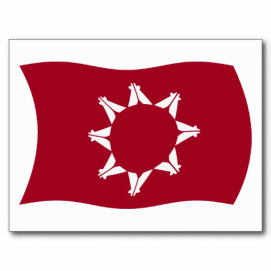
The Pine Ridge Indian Reservation (Wazà Aháŋhaŋ Oyáŋke in Lakota, also called Pine Ridge Agency) is an Oglala Sioux Native American reservation located in the U.S. state of South Dakota. Originally included within the territory of the Great Sioux Reservation, Pine Ridge was established in 1889 in the southwest corner of South Dakota on the Nebraska border. Today it consists of 3,468.86 sq mi (8,984.306 km2) of land area and is the eighth-largest reservation in the United States, larger than Delaware and Rhode Island combined.
The reservation encompasses the entirety of Shannon County, the southern half of Jackson County and the northwest portion of Bennett County. Of the 3,143 counties in the United States, these are among the poorest. Only 84,000 acres (340 km2) of land are suitable for agriculture. Extensive off-reservation trust lands are held mostly scattered throughout Bennett County (all of Bennett County was part of Pine Ridge until May 1910),[1][2] and also extend into adjacent Pine Ridge, Nebraska in Sheridan County, just south of the community of Pine Ridge, South Dakota, the administrative center and largest community within the reservation. The 2000 census population of the reservation was 15,521; but a study conducted by Colorado State University and accepted by the United States Department of Housing and Urban Development has estimated the resident population to reach 28,787.[3]
Pine Ridge is the site of several events that marked tragic milestones in the history between the Sioux of the area and the United States (U.S.) government and its citizens. Stronghold Table — a mesa in what is today the Oglala-administered portion of Badlands National Park — was the location of the last of the Ghost Dances. The U.S. authorities' attempt to repress this movement eventually led to the Wounded Knee Massacre on December 29, 1890. A mixed band of Miniconjou Lakota and Hunkpapa Sioux, led by Chief Spotted Elk, sought sanctuary at Pine Ridge after fleeing the Standing Rock Agency, where Sitting Bull had been killed during efforts to arrest him. The families were intercepted by a heavily armed detachment of the Seventh Cavalry, which attacked them, killing many women and children as well as warriors. This was the last large engagement between U.S. forces and Native Americans and marked the end of the western frontier.
Changes accumulated in the last quarter of the 20th century; in 1971 the Oglala Sioux Tribe (OST) started Oglala Lakota College, a tribal college, which offers 4-year degrees. In 1973 decades of discontent at the Pine Ridge Reservation resulted in a grassroots protest that escalated into the Wounded Knee Incident, gaining national attention. Members of the Oglala Lakota, the American Indian Movement, and supporters occupied the town in defiance of federal and state law enforcement in a protest that turned into an armed standoff lasting 71 days. This event inspired American Indians across the country and gradually led to changes at the reservation, with a revival of some cultural traditions. In 1981 the Lakota Tim Giago started the Lakota Times at Pine Ridge, the first independent Native American newspaper in the nation, which he published until selling it in 1998.
At the southern end of the Badlands, the reservation is part of the mixed grass prairie, an ecological transition zone between the short-grass and tall-grass prairies; all are part of the Great Plains. A great variety of plant and animal life flourishes on and adjacent to the reservation, including the endangered black-footed ferret. The area is also important in the field of paleontology; it contains deposits of Pierre Shale formed on the seafloor of the Western Interior Seaway, evidence of the marine Cretaceous–Paleogene boundary, and one of the largest deposits of fossils of extinct mammals from the Oligocene epoch.
19TH CENTURY - GREAT SIOUX RESERVATION
Red Cloud Agency
I know of no other instance in history where a great nation has so shamefully violated its oath. Our country must forever bear the disgrace and suffer the retribution of its wrongdoing. Our children's children will tell the sad story in hushed tones, and wonder how their fathers dared so to trample on justice and trifle with God. —Henry Benjamin Whipple, chairman of Bureau of Indian Affairs (BIA), on the taking of the Black Hills; statements made in official BIA report As stipulated in the Fort Laramie Treaty (1868), the U.S. government built Indian agencies for the various Lakota and other Plains tribes. These were forerunners to the modern Indian reservations. The Red Cloud Agency was established for the Oglala Lakota in 1871 on the North Platte River in Wyoming Territory. The location was one mile (1.6 km) west of the present town of Henry, Nebraska. The location of the Red Cloud Agency was moved to two other locations before being settled at the present Pine Ridge location. Pine Ridge Reservation was originally part of the Great Sioux Reservation established by the Fort Laramie Treaty of 1868; it encompassed approximately 60 million contiguous acres (240,000 km2) of western South Dakota (all of what is now called West River), northern Nebraska and eastern Wyoming.
Loss of the Black Hills
In 1874 George Armstrong Custer led the U.S. Army Black Hills Expedition, which set out on July 2 from Fort Abraham Lincoln in the Dakota Territory, with orders to travel to the previously uncharted Black Hills of South Dakota. Its mission was to look for suitable locations for a fort, find a route to the southwest, and to investigate the potential for gold mining. His discovery of gold was made public and miners began migrating there illegally.
"Custer's florid descriptions of the mineral and timber resources of the Black Hills, and the land's suitability for grazing and cultivation ... received wide circulation, and had the effect of creating an intense popular demand for the 'opening' of the Hills for settlement. "Initially the U.S. military tried to turn away trespassing miners and settlers. Eventually President Grant, the Secretary of the Interior, and the Secretary of War, "decided that the military should make no further resistance to the occupation of the Black Hills by miners."These orders were to be enforced "quietly", and the President's decision was to remain "confidential."
As more settlers and gold miners invaded the Black Hills, the Government determined it had to acquire the land from the Sioux, and appointed a commission to negotiate the purchase. The negotiations failed, as the Sioux resisted giving up what they considered sacred land. The U.S. resorted to military force. They declared the Sioux Indians "hostile" for failing to obey an order to return from an off-reservation hunting expedition by a specific date, but in the dead of winter, overland travel was impossible.
The consequent military expedition to remove the Sioux from the Black Hills included an attack on a major encampment of several bands on the Little Bighorn River. Led by General Custer, the attack ended in the overwhelming victory of chiefs Sitting Bull and Crazy Horse over the 7th Cavalry Regiment, a conflict often called Custer's Last Stand.
In 1876 the U.S. Congress decided to open up the Black Hills to development and break up the Great Sioux Reservation. In 1877, it passed an act to make 7.7 million acres (31,000 km2) of the Black Hills available for sale to homesteaders and private interests. In 1889 Congress divided the remaining area of Great Sioux Reservation into five separate reservations and defined the boundaries of each in its Act of March 2, 1889, 25 Stat. 888.
Wounded Knee Massacre
The Wounded Knee Massacre occurred on December 29, 1890, near Wounded Knee Creek (Lakota: Cankpe Opi Wakpala). On the day before, a detachment of the U.S. 7th Cavalry Regiment commanded by Major Samuel M. Whitside intercepted Spotted Elk's (Big Foot) band of Miniconjou Lakota and 38 Hunkpapa Lakota near Porcupine Butte and escorted them 5 miles (8.0 km) westward to Wounded Knee Creek where they made camp. The rest of the 7th Cavalry Regiment, led by Colonel James Forsyth, surrounded the encampment, supported by four Hotchkiss guns.
On the morning of December 29, the troops went into the camp to disarm the Lakota. One version of events claims that during the process, a deaf tribesman named Black Coyote was reluctant to give up his rifle, saying he had paid a lot for it. A scuffle over Black Coyote's rifle escalated and a shot was fired, which resulted in the 7th Cavalry opening firing indiscriminately from all sides, killing men, women, and children, as well as some of their fellow troopers. Those few Lakota warriors who still had weapons began shooting back at the troopers, who quickly suppressed the Lakota fire. The surviving Lakota fled, but U.S. cavalrymen pursued and killed many who were unarmed.
In the end, U.S. forces killed at least 150 men, women, and children of the Lakota Sioux and wounded 51 (four men, and 47 women and children, some of whom died later); some estimates placed the number of dead at 300. Twenty-five troopers also died, and thirty-nine were wounded (six of the wounded would also die). Many Army victims were believed to have died by friendly fire, as the shooting took place at close range in chaotic conditions.
The site has been designated a National Historic Landmark and is administered by the National Park Service.
20TH CENTURY
The White Clay Extension
In 1882, at the urging of Valentine McGillycuddy — the Indian Agent at the Pine President Agency — President Chester A. Arthur issued an executive order establishing the White Clay Extension, an area of land in Nebraska extending five miles south of the reservation's border and ten miles wide approximately perpendicular to the road leading north into the town of Pine Ridge on the reservation — today's Nebraska Highway 87. McGillycuddy lobbied for the buffer zone to prevent white peddlers from engaging in the illegal sale of "knives, guns, and alcohol" to the Oglala Lakota inhabitants of Pine Ridge.
A law passed in Congress in 1832 banned the sale of alcohol to Native Americans. The ban was ended in 1953 by Public Law 277, signed by President Dwight D. Eisenhower. The amended law gave Native American tribes the option of permitting or banning alcohol sales and consumption on their lands. The OST and many other tribes chose to exclude alcohol from their reservations because of the problems for their people. Today, 200 of the 293 reservations in the 48 contiguous states have banned alcohol sales in their territories.
In 1887, when Congress enacted the Dawes Severalty Act of 1887 — breaking up the reservations and giving the head of each family a 160-acre allotment — the Whiteclay Extension was specifically exempted. On March 2, 1889 the U.S. Congress enacted the Great Sioux Agreement of March 2, 1889, 25 Stat. 888,. breaking up the Great Sioux Reservation and setting boundaries for the six reduced reservations. In this act, the White Clay Extension was again incorporated within the boundaries of the Pine Ridge Agency. "Provided, That the said tract of land in the State of Nebraska shall be reserved, by Executive order, only so long as it may be needed for the use and protection of the Indians receiving rations and annuities at the Pine Ridge Agency."
On January 25, 1904, President Theodore Roosevelt signed an executive order returning the 50 square miles of the of the White Clay Extension into the public domain. The town of Whiteclay in Sheridan County, Nebraska, just over the border from the reservation, was established in the former "Extension" zone and quickly started selling alcohol to the Oglala Sioux.
It is hereby ordered that the tract of country in the State of Nebraska “withdrawn from sale and set aside as an addition to the present Sioux Indian Reservation in the Territory of Dakota†by Executive order dated January 24, 1882, be, and the same hereby is, restored to the public domain.~ President Theodore Roosevelt-January 25, 1904. On February 20, 1904, Roosevelt amended the executive order to return one square mile back to Pine Ridge: "the section of land embracing the Pine Ridge Boarding School irrigation ditch and the school pasture".
Bennett County Land Dispute
No land changes were made within Pine Ridge until the U.S. Congress passed the Pine Ridge Act of May 27, 1910 (§1, 36 Stat. 440), by which most of the southeastern portion of Pine Ridge located within Bennett County was sold off.
"... (T)he Secretary of the Interior be, and he is hereby authorized and directed, as hereinafter provided, to sell and dispose of all that portion of the Pine Ridge Indian Reservation, in the State of South Dakota, lying and being in Bennett County and described as follows ..." (Act of May 27, 1910, §1 (36 Stat. 440).
"Provided that any Indian to whom allotments have been made on the tract to be ceded may, in case they elect to do so before said lands are offered for sale, relinquish same and select allotments in lieu thereof on the diminished reservation."
The South Dakota Legislature determined the boundaries of Bennett County in 1909, while the land area was still part of the reservation.
"The United States participated only as amicus before the Eighth Circuit Court of Appeals in Cook v. Parkinson, 525 F.2d 120 (8th Cir. 1975), a criminal case that discussed Bennett County as no longer being part of the Reservation. The United States is not bound by that decision because it did not participate in the litigation. The United states was part in United States v. Bennett County, 394 F.2d 8 (8th Cir. 1968), in which the State of South Dakota had to obtain permission from the Department of Interior in order to fix roads or condemn property Bennett County, consistent with the property's Reservation status."
Indian Reorganization Act
During the 1930s, President Franklin D. Roosevelt's administration tried to make some changes to benefit American Indians. In response to complaints about corruption and injustices in the BIA management of reservations, Congress passed the Indian Reorganization Act of 1934, permitting tribal nations to reorganize with self-government. It encouraged a model of elected representative governments and elected tribal chairmen or presidents, with written constitutions, further eroding the traditional hereditary leaders of the clan system.
The Oglala Sioux Tribe developed a tribal government along such lines, with a chairman to be elected for a two-year term. This short term makes it difficult for leaders to accomplish longer-term projects, but the tribe has not changed its constitution. The BIA still has had the ability to oversee some tribal operations, including the police, who were often assigned from other Indian tribes rather than representing local people. Many traditionalists among the Oglala Lakota never supported the new style of government; tribal elders were still respected, and there were multiple lines of authority and influence among different groups on the reservation. Political factions also formed between those who were mixed-bloods or had urban experiences, and those who were full-bloods and tended to be more traditional in practices and culture.
The people continued to be under assimilation pressure: through the early part of the century, many children were sent away to Indian boarding schools where they were usually required to speak English and were prohibited from speaking Lakota. They were usually expected to practice Christianity rather than native religions. Many institutions were found to have had staff who abused the children in their care
Taking of Badlands Bombing Range
During World War II, in 1942 the Department of War annexed 341,725 acres (1,382.91 km2) of the Pine Ridge Indian Reservation for use by the United States Army Air Forces as an aerial gunnery and bombing range. It condemned privately held land owned by tribal members and leased communally held tribal land.
Among the 125 families forced to give up their land was that of Pat Cuny. He was an Oglala soldier with the 83rd Infantry Division, who landed in Normandy at Omaha Beach two weeks after the Normandy invasion in 1944 after his transport was torpedoed in the English Channel, fought in the Battle of the Bulge, helped liberate the Langenstein concentration camp, and fought to the final conquest of Nazi Germany.
Another family forced to give up their land was that of Dewey Beard, a Miniconjou Sioux survivor of the Wounded Knee Massacre. One of the models for the Indian Head nickel, he was 84 years old at the time of the taking and still supported himself by raising horses on his 908-acre (3.67 km2) allotment received in 1907. The compensation provided by the government was nominal and paid out in small installments insufficient to make a down payment on other property; Dewey Beard and others like him became homeless. He testified before Congressional hearings in 1955 when the Sioux sought to address their grievances over the land-taking.
"For fifty years I have been kicked around. Today there is a hard winter coming. I do not know whether I am to keep warm, or whether to live, and the chance is I might starve to death."~Dewey Beard's 1955 testimony before Congress at age 97 on the taking of his land for inclusion in the Badlands Bombing Range.
The U.S. military used the Badland Bombing Range (BBR), the largest portion of which is located in Shannon County, as a live-fire range for 30 years. Most recently, the Air National Guard used it as a training range. Since 1960, the U.S. returned portions of the range to the Oglala Sioux Tribe (OST) in a piecemeal fashion. In 1968 Congress enacted Public Law 90-468, authorizing the return of 202,357 acres (818.91 km2) to the OST, but also setting aside 136,882 acres (553.94 km2) of former tribal lands to establish Badlands National Monument, to be managed by the National Park Service. The U.S. Air Force maintained 2,486 acres (10.06 km2) of land on Bouquet Table within the boundaries of the reservation. The land has recently been cleared of the last unexploded munitions by contractors from the 28th Civil Engineer Squadron and Native American Engineering in a joint effort between the Air Force and the Ogala Sioux Tribe for eventual return to the reservation.
Wounded Knee Incident
In the early 1970s, tribal tensions rose and some turned to the American Indian Movement (AIM) for help. Longstanding divisions on the reservation resulted from deep-seated political, ethnic and cultural differences. Many residents did not support the tribal government. Many residents were upset about what they described as the autocratic and repressive actions by the current tribal president Dick Wilson, elected in 1972. He was criticized for favoring family and friends with jobs and benefits, not consulting with the tribal council, and creating a private militia, Guardians of the Oglala Nation (GOONs), to suppress political opponents, which he paid from tribal funds.
After an attempt to impeach Wilson failed, his opponents had a grassroots uprising. Women elders such as Ellen Moves Camp, founder of the Oglala Sioux Civil Rights Organization (OSCRO), called for action. They organized a public protest.
About 200 AIM and Oglala Lakota activists occupied the hamlet of Wounded Knee on February 27, 1973. They demanded the removal of Wilson, restoration of treaty negotiations with the U.S. government, and correction of U.S. failures to enforce treaty rights. Visits by the U.S. senators from South Dakota, FBI agents and United States Department of Justice (DOJ) representatives, were attended by widespread media coverage, but the Richard Nixon administration was preoccupied internally with Watergate.
As the events evolved, the activists at Wounded Knee had a 71-day armed stand-off with U.S. law enforcement. AIM leaders at the site were Russell Means, Dennis Banks and Carter Camp; traditional spiritual leaders of the Lakota, such as Frank Fools Crow, were also prominent. Fools Crow led Oglala Lakota spiritual ceremonies and practice in their ways for participants. Joseph H. Trimbach of the FBI and Steve Frizell of DOJ led the government.
Casualties of gunfire included a U.S. Marshal, who was seriously wounded and paralyzed; and the deaths of Frank Clearwater, a Cherokee from North Carolina, and Buddy Lamont, a local Oglala Lakota. After Lamont's death, the Oglala Lakota elders called an end to the occupation. Some Lakota have alleged that Ray Robinson, a civil rights activist, was killed during the Wounded Knee occupation, as he disappeared there.
The stand-off ended, but Wilson remained in office. (The U.S. government said it could not remove an elected tribal official as the Oglala Sioux Tribe had sovereignty. Ensuing open conflict between factions caused numerous deaths. The murder rate between March 1, 1973, and March 1, 1976, was 170 per 100,000; it was the highest in the country. More than 60 opponents of the tribal government died violent deaths in the three years following the Wounded Knee Incident, a period called the "Reign of Terror" by many residents. Among those killed was Pedro Bissonette, executive director of the civil rights organization OSCRO. Residents accused officials of failing to try to solve the deaths. In 2000, the FBI released a report that accounted for most of the deaths, and disputed the claims of unsolved murders. AIM representatives criticized the FBI report.
Pine Ridge Shootout
In this period of increased violence, on June 26, 1975, the reservation was the site of an armed confrontation between AIM activists and the FBI, which became known as the Pine Ridge Shootout. Two FBI agents, Jack R. Coler and Ronald A. Williams, and the AIM activist Jim Stuntz were killed. The U.S. prosecution of suspects in the execution-style deaths of the FBI agents led to trials: AIM members Robert Robideau and Dino Butler were acquitted. Leonard Peltier was extradited from Canada, tried separately because of the delay, and convicted of aiding and abetting the murders of the two FBI agents. He was sentenced to two consecutive life sentences and has not been granted parole.
Murder of Anna Mae Aquash
On February 24, 1976, the body of Anna Mae Aquash, a Mi'kmaq activist and the most prominent woman in AIM, was found in the far northeast corner of the Pine Ridge Reservation. Missing since December 1975, she had been shot execution-style. At the time, some AIM people said that she was a government informant, but the FBI has denied that. In 1974 AIM had discovered that Douglas Durham, then head of security, was an FBI informant. Three federal grand juries were called to hear testimony on the Aquash murder: in 1976, 1982 and 1994, but it was more than a quarter of a century before any suspects were indicted and tried for the crime. Two AIM members, Arlo Looking Cloud and John Graham, were convicted of her murder in 2004 and 2010 respectively, and sentenced to life in prison. Bruce Ellison, Leonard Peltier's lawyer since the 1970s, invoked his Fifth Amendment rights and refused to testify at the grand jury hearings on Looking Cloud or at his trial in 2004. At trial, the federal prosecutor referred to Ellison as a co-conspirator in the Aquash case.
The reservation encompasses the entirety of Shannon County, the southern half of Jackson County and the northwest portion of Bennett County. Of the 3,143 counties in the United States, these are among the poorest. Only 84,000 acres (340 km2) of land are suitable for agriculture. Extensive off-reservation trust lands are held mostly scattered throughout Bennett County (all of Bennett County was part of Pine Ridge until May 1910),[1][2] and also extend into adjacent Pine Ridge, Nebraska in Sheridan County, just south of the community of Pine Ridge, South Dakota, the administrative center and largest community within the reservation. The 2000 census population of the reservation was 15,521; but a study conducted by Colorado State University and accepted by the United States Department of Housing and Urban Development has estimated the resident population to reach 28,787.[3]
Pine Ridge is the site of several events that marked tragic milestones in the history between the Sioux of the area and the United States (U.S.) government and its citizens. Stronghold Table — a mesa in what is today the Oglala-administered portion of Badlands National Park — was the location of the last of the Ghost Dances. The U.S. authorities' attempt to repress this movement eventually led to the Wounded Knee Massacre on December 29, 1890. A mixed band of Miniconjou Lakota and Hunkpapa Sioux, led by Chief Spotted Elk, sought sanctuary at Pine Ridge after fleeing the Standing Rock Agency, where Sitting Bull had been killed during efforts to arrest him. The families were intercepted by a heavily armed detachment of the Seventh Cavalry, which attacked them, killing many women and children as well as warriors. This was the last large engagement between U.S. forces and Native Americans and marked the end of the western frontier.
Changes accumulated in the last quarter of the 20th century; in 1971 the Oglala Sioux Tribe (OST) started Oglala Lakota College, a tribal college, which offers 4-year degrees. In 1973 decades of discontent at the Pine Ridge Reservation resulted in a grassroots protest that escalated into the Wounded Knee Incident, gaining national attention. Members of the Oglala Lakota, the American Indian Movement, and supporters occupied the town in defiance of federal and state law enforcement in a protest that turned into an armed standoff lasting 71 days. This event inspired American Indians across the country and gradually led to changes at the reservation, with a revival of some cultural traditions. In 1981 the Lakota Tim Giago started the Lakota Times at Pine Ridge, the first independent Native American newspaper in the nation, which he published until selling it in 1998.
At the southern end of the Badlands, the reservation is part of the mixed grass prairie, an ecological transition zone between the short-grass and tall-grass prairies; all are part of the Great Plains. A great variety of plant and animal life flourishes on and adjacent to the reservation, including the endangered black-footed ferret. The area is also important in the field of paleontology; it contains deposits of Pierre Shale formed on the seafloor of the Western Interior Seaway, evidence of the marine Cretaceous–Paleogene boundary, and one of the largest deposits of fossils of extinct mammals from the Oligocene epoch.
19TH CENTURY - GREAT SIOUX RESERVATION
Red Cloud Agency
I know of no other instance in history where a great nation has so shamefully violated its oath. Our country must forever bear the disgrace and suffer the retribution of its wrongdoing. Our children's children will tell the sad story in hushed tones, and wonder how their fathers dared so to trample on justice and trifle with God. —Henry Benjamin Whipple, chairman of Bureau of Indian Affairs (BIA), on the taking of the Black Hills; statements made in official BIA report As stipulated in the Fort Laramie Treaty (1868), the U.S. government built Indian agencies for the various Lakota and other Plains tribes. These were forerunners to the modern Indian reservations. The Red Cloud Agency was established for the Oglala Lakota in 1871 on the North Platte River in Wyoming Territory. The location was one mile (1.6 km) west of the present town of Henry, Nebraska. The location of the Red Cloud Agency was moved to two other locations before being settled at the present Pine Ridge location. Pine Ridge Reservation was originally part of the Great Sioux Reservation established by the Fort Laramie Treaty of 1868; it encompassed approximately 60 million contiguous acres (240,000 km2) of western South Dakota (all of what is now called West River), northern Nebraska and eastern Wyoming.
Loss of the Black Hills
In 1874 George Armstrong Custer led the U.S. Army Black Hills Expedition, which set out on July 2 from Fort Abraham Lincoln in the Dakota Territory, with orders to travel to the previously uncharted Black Hills of South Dakota. Its mission was to look for suitable locations for a fort, find a route to the southwest, and to investigate the potential for gold mining. His discovery of gold was made public and miners began migrating there illegally.
"Custer's florid descriptions of the mineral and timber resources of the Black Hills, and the land's suitability for grazing and cultivation ... received wide circulation, and had the effect of creating an intense popular demand for the 'opening' of the Hills for settlement. "Initially the U.S. military tried to turn away trespassing miners and settlers. Eventually President Grant, the Secretary of the Interior, and the Secretary of War, "decided that the military should make no further resistance to the occupation of the Black Hills by miners."These orders were to be enforced "quietly", and the President's decision was to remain "confidential."
As more settlers and gold miners invaded the Black Hills, the Government determined it had to acquire the land from the Sioux, and appointed a commission to negotiate the purchase. The negotiations failed, as the Sioux resisted giving up what they considered sacred land. The U.S. resorted to military force. They declared the Sioux Indians "hostile" for failing to obey an order to return from an off-reservation hunting expedition by a specific date, but in the dead of winter, overland travel was impossible.
The consequent military expedition to remove the Sioux from the Black Hills included an attack on a major encampment of several bands on the Little Bighorn River. Led by General Custer, the attack ended in the overwhelming victory of chiefs Sitting Bull and Crazy Horse over the 7th Cavalry Regiment, a conflict often called Custer's Last Stand.
In 1876 the U.S. Congress decided to open up the Black Hills to development and break up the Great Sioux Reservation. In 1877, it passed an act to make 7.7 million acres (31,000 km2) of the Black Hills available for sale to homesteaders and private interests. In 1889 Congress divided the remaining area of Great Sioux Reservation into five separate reservations and defined the boundaries of each in its Act of March 2, 1889, 25 Stat. 888.
Wounded Knee Massacre
The Wounded Knee Massacre occurred on December 29, 1890, near Wounded Knee Creek (Lakota: Cankpe Opi Wakpala). On the day before, a detachment of the U.S. 7th Cavalry Regiment commanded by Major Samuel M. Whitside intercepted Spotted Elk's (Big Foot) band of Miniconjou Lakota and 38 Hunkpapa Lakota near Porcupine Butte and escorted them 5 miles (8.0 km) westward to Wounded Knee Creek where they made camp. The rest of the 7th Cavalry Regiment, led by Colonel James Forsyth, surrounded the encampment, supported by four Hotchkiss guns.
On the morning of December 29, the troops went into the camp to disarm the Lakota. One version of events claims that during the process, a deaf tribesman named Black Coyote was reluctant to give up his rifle, saying he had paid a lot for it. A scuffle over Black Coyote's rifle escalated and a shot was fired, which resulted in the 7th Cavalry opening firing indiscriminately from all sides, killing men, women, and children, as well as some of their fellow troopers. Those few Lakota warriors who still had weapons began shooting back at the troopers, who quickly suppressed the Lakota fire. The surviving Lakota fled, but U.S. cavalrymen pursued and killed many who were unarmed.
In the end, U.S. forces killed at least 150 men, women, and children of the Lakota Sioux and wounded 51 (four men, and 47 women and children, some of whom died later); some estimates placed the number of dead at 300. Twenty-five troopers also died, and thirty-nine were wounded (six of the wounded would also die). Many Army victims were believed to have died by friendly fire, as the shooting took place at close range in chaotic conditions.
The site has been designated a National Historic Landmark and is administered by the National Park Service.
20TH CENTURY
The White Clay Extension
In 1882, at the urging of Valentine McGillycuddy — the Indian Agent at the Pine President Agency — President Chester A. Arthur issued an executive order establishing the White Clay Extension, an area of land in Nebraska extending five miles south of the reservation's border and ten miles wide approximately perpendicular to the road leading north into the town of Pine Ridge on the reservation — today's Nebraska Highway 87. McGillycuddy lobbied for the buffer zone to prevent white peddlers from engaging in the illegal sale of "knives, guns, and alcohol" to the Oglala Lakota inhabitants of Pine Ridge.
A law passed in Congress in 1832 banned the sale of alcohol to Native Americans. The ban was ended in 1953 by Public Law 277, signed by President Dwight D. Eisenhower. The amended law gave Native American tribes the option of permitting or banning alcohol sales and consumption on their lands. The OST and many other tribes chose to exclude alcohol from their reservations because of the problems for their people. Today, 200 of the 293 reservations in the 48 contiguous states have banned alcohol sales in their territories.
In 1887, when Congress enacted the Dawes Severalty Act of 1887 — breaking up the reservations and giving the head of each family a 160-acre allotment — the Whiteclay Extension was specifically exempted. On March 2, 1889 the U.S. Congress enacted the Great Sioux Agreement of March 2, 1889, 25 Stat. 888,. breaking up the Great Sioux Reservation and setting boundaries for the six reduced reservations. In this act, the White Clay Extension was again incorporated within the boundaries of the Pine Ridge Agency. "Provided, That the said tract of land in the State of Nebraska shall be reserved, by Executive order, only so long as it may be needed for the use and protection of the Indians receiving rations and annuities at the Pine Ridge Agency."
On January 25, 1904, President Theodore Roosevelt signed an executive order returning the 50 square miles of the of the White Clay Extension into the public domain. The town of Whiteclay in Sheridan County, Nebraska, just over the border from the reservation, was established in the former "Extension" zone and quickly started selling alcohol to the Oglala Sioux.
It is hereby ordered that the tract of country in the State of Nebraska “withdrawn from sale and set aside as an addition to the present Sioux Indian Reservation in the Territory of Dakota†by Executive order dated January 24, 1882, be, and the same hereby is, restored to the public domain.~ President Theodore Roosevelt-January 25, 1904. On February 20, 1904, Roosevelt amended the executive order to return one square mile back to Pine Ridge: "the section of land embracing the Pine Ridge Boarding School irrigation ditch and the school pasture".
Bennett County Land Dispute
No land changes were made within Pine Ridge until the U.S. Congress passed the Pine Ridge Act of May 27, 1910 (§1, 36 Stat. 440), by which most of the southeastern portion of Pine Ridge located within Bennett County was sold off.
"... (T)he Secretary of the Interior be, and he is hereby authorized and directed, as hereinafter provided, to sell and dispose of all that portion of the Pine Ridge Indian Reservation, in the State of South Dakota, lying and being in Bennett County and described as follows ..." (Act of May 27, 1910, §1 (36 Stat. 440).
"Provided that any Indian to whom allotments have been made on the tract to be ceded may, in case they elect to do so before said lands are offered for sale, relinquish same and select allotments in lieu thereof on the diminished reservation."
The South Dakota Legislature determined the boundaries of Bennett County in 1909, while the land area was still part of the reservation.
"The United States participated only as amicus before the Eighth Circuit Court of Appeals in Cook v. Parkinson, 525 F.2d 120 (8th Cir. 1975), a criminal case that discussed Bennett County as no longer being part of the Reservation. The United States is not bound by that decision because it did not participate in the litigation. The United states was part in United States v. Bennett County, 394 F.2d 8 (8th Cir. 1968), in which the State of South Dakota had to obtain permission from the Department of Interior in order to fix roads or condemn property Bennett County, consistent with the property's Reservation status."
Indian Reorganization Act
During the 1930s, President Franklin D. Roosevelt's administration tried to make some changes to benefit American Indians. In response to complaints about corruption and injustices in the BIA management of reservations, Congress passed the Indian Reorganization Act of 1934, permitting tribal nations to reorganize with self-government. It encouraged a model of elected representative governments and elected tribal chairmen or presidents, with written constitutions, further eroding the traditional hereditary leaders of the clan system.
The Oglala Sioux Tribe developed a tribal government along such lines, with a chairman to be elected for a two-year term. This short term makes it difficult for leaders to accomplish longer-term projects, but the tribe has not changed its constitution. The BIA still has had the ability to oversee some tribal operations, including the police, who were often assigned from other Indian tribes rather than representing local people. Many traditionalists among the Oglala Lakota never supported the new style of government; tribal elders were still respected, and there were multiple lines of authority and influence among different groups on the reservation. Political factions also formed between those who were mixed-bloods or had urban experiences, and those who were full-bloods and tended to be more traditional in practices and culture.
The people continued to be under assimilation pressure: through the early part of the century, many children were sent away to Indian boarding schools where they were usually required to speak English and were prohibited from speaking Lakota. They were usually expected to practice Christianity rather than native religions. Many institutions were found to have had staff who abused the children in their care
Taking of Badlands Bombing Range
During World War II, in 1942 the Department of War annexed 341,725 acres (1,382.91 km2) of the Pine Ridge Indian Reservation for use by the United States Army Air Forces as an aerial gunnery and bombing range. It condemned privately held land owned by tribal members and leased communally held tribal land.
Among the 125 families forced to give up their land was that of Pat Cuny. He was an Oglala soldier with the 83rd Infantry Division, who landed in Normandy at Omaha Beach two weeks after the Normandy invasion in 1944 after his transport was torpedoed in the English Channel, fought in the Battle of the Bulge, helped liberate the Langenstein concentration camp, and fought to the final conquest of Nazi Germany.
Another family forced to give up their land was that of Dewey Beard, a Miniconjou Sioux survivor of the Wounded Knee Massacre. One of the models for the Indian Head nickel, he was 84 years old at the time of the taking and still supported himself by raising horses on his 908-acre (3.67 km2) allotment received in 1907. The compensation provided by the government was nominal and paid out in small installments insufficient to make a down payment on other property; Dewey Beard and others like him became homeless. He testified before Congressional hearings in 1955 when the Sioux sought to address their grievances over the land-taking.
"For fifty years I have been kicked around. Today there is a hard winter coming. I do not know whether I am to keep warm, or whether to live, and the chance is I might starve to death."~Dewey Beard's 1955 testimony before Congress at age 97 on the taking of his land for inclusion in the Badlands Bombing Range.
The U.S. military used the Badland Bombing Range (BBR), the largest portion of which is located in Shannon County, as a live-fire range for 30 years. Most recently, the Air National Guard used it as a training range. Since 1960, the U.S. returned portions of the range to the Oglala Sioux Tribe (OST) in a piecemeal fashion. In 1968 Congress enacted Public Law 90-468, authorizing the return of 202,357 acres (818.91 km2) to the OST, but also setting aside 136,882 acres (553.94 km2) of former tribal lands to establish Badlands National Monument, to be managed by the National Park Service. The U.S. Air Force maintained 2,486 acres (10.06 km2) of land on Bouquet Table within the boundaries of the reservation. The land has recently been cleared of the last unexploded munitions by contractors from the 28th Civil Engineer Squadron and Native American Engineering in a joint effort between the Air Force and the Ogala Sioux Tribe for eventual return to the reservation.
Wounded Knee Incident
In the early 1970s, tribal tensions rose and some turned to the American Indian Movement (AIM) for help. Longstanding divisions on the reservation resulted from deep-seated political, ethnic and cultural differences. Many residents did not support the tribal government. Many residents were upset about what they described as the autocratic and repressive actions by the current tribal president Dick Wilson, elected in 1972. He was criticized for favoring family and friends with jobs and benefits, not consulting with the tribal council, and creating a private militia, Guardians of the Oglala Nation (GOONs), to suppress political opponents, which he paid from tribal funds.
After an attempt to impeach Wilson failed, his opponents had a grassroots uprising. Women elders such as Ellen Moves Camp, founder of the Oglala Sioux Civil Rights Organization (OSCRO), called for action. They organized a public protest.
About 200 AIM and Oglala Lakota activists occupied the hamlet of Wounded Knee on February 27, 1973. They demanded the removal of Wilson, restoration of treaty negotiations with the U.S. government, and correction of U.S. failures to enforce treaty rights. Visits by the U.S. senators from South Dakota, FBI agents and United States Department of Justice (DOJ) representatives, were attended by widespread media coverage, but the Richard Nixon administration was preoccupied internally with Watergate.
As the events evolved, the activists at Wounded Knee had a 71-day armed stand-off with U.S. law enforcement. AIM leaders at the site were Russell Means, Dennis Banks and Carter Camp; traditional spiritual leaders of the Lakota, such as Frank Fools Crow, were also prominent. Fools Crow led Oglala Lakota spiritual ceremonies and practice in their ways for participants. Joseph H. Trimbach of the FBI and Steve Frizell of DOJ led the government.
Casualties of gunfire included a U.S. Marshal, who was seriously wounded and paralyzed; and the deaths of Frank Clearwater, a Cherokee from North Carolina, and Buddy Lamont, a local Oglala Lakota. After Lamont's death, the Oglala Lakota elders called an end to the occupation. Some Lakota have alleged that Ray Robinson, a civil rights activist, was killed during the Wounded Knee occupation, as he disappeared there.
The stand-off ended, but Wilson remained in office. (The U.S. government said it could not remove an elected tribal official as the Oglala Sioux Tribe had sovereignty. Ensuing open conflict between factions caused numerous deaths. The murder rate between March 1, 1973, and March 1, 1976, was 170 per 100,000; it was the highest in the country. More than 60 opponents of the tribal government died violent deaths in the three years following the Wounded Knee Incident, a period called the "Reign of Terror" by many residents. Among those killed was Pedro Bissonette, executive director of the civil rights organization OSCRO. Residents accused officials of failing to try to solve the deaths. In 2000, the FBI released a report that accounted for most of the deaths, and disputed the claims of unsolved murders. AIM representatives criticized the FBI report.
Pine Ridge Shootout
In this period of increased violence, on June 26, 1975, the reservation was the site of an armed confrontation between AIM activists and the FBI, which became known as the Pine Ridge Shootout. Two FBI agents, Jack R. Coler and Ronald A. Williams, and the AIM activist Jim Stuntz were killed. The U.S. prosecution of suspects in the execution-style deaths of the FBI agents led to trials: AIM members Robert Robideau and Dino Butler were acquitted. Leonard Peltier was extradited from Canada, tried separately because of the delay, and convicted of aiding and abetting the murders of the two FBI agents. He was sentenced to two consecutive life sentences and has not been granted parole.
Murder of Anna Mae Aquash
On February 24, 1976, the body of Anna Mae Aquash, a Mi'kmaq activist and the most prominent woman in AIM, was found in the far northeast corner of the Pine Ridge Reservation. Missing since December 1975, she had been shot execution-style. At the time, some AIM people said that she was a government informant, but the FBI has denied that. In 1974 AIM had discovered that Douglas Durham, then head of security, was an FBI informant. Three federal grand juries were called to hear testimony on the Aquash murder: in 1976, 1982 and 1994, but it was more than a quarter of a century before any suspects were indicted and tried for the crime. Two AIM members, Arlo Looking Cloud and John Graham, were convicted of her murder in 2004 and 2010 respectively, and sentenced to life in prison. Bruce Ellison, Leonard Peltier's lawyer since the 1970s, invoked his Fifth Amendment rights and refused to testify at the grand jury hearings on Looking Cloud or at his trial in 2004. At trial, the federal prosecutor referred to Ellison as a co-conspirator in the Aquash case.
*Information on Oglala Lakota history taken from: http://www.oglalalakotanation.org/oln/History.html.
